How Are Scammers Cloning Your Voice to Hack Banks?
Criminals no longer need to fool you. They call your bank, sound like you, answer your security questions with leaked data, and take over your account while your phone stays silent. Voice ID and security questions are now liabilities, and you can shut them down this afternoon.
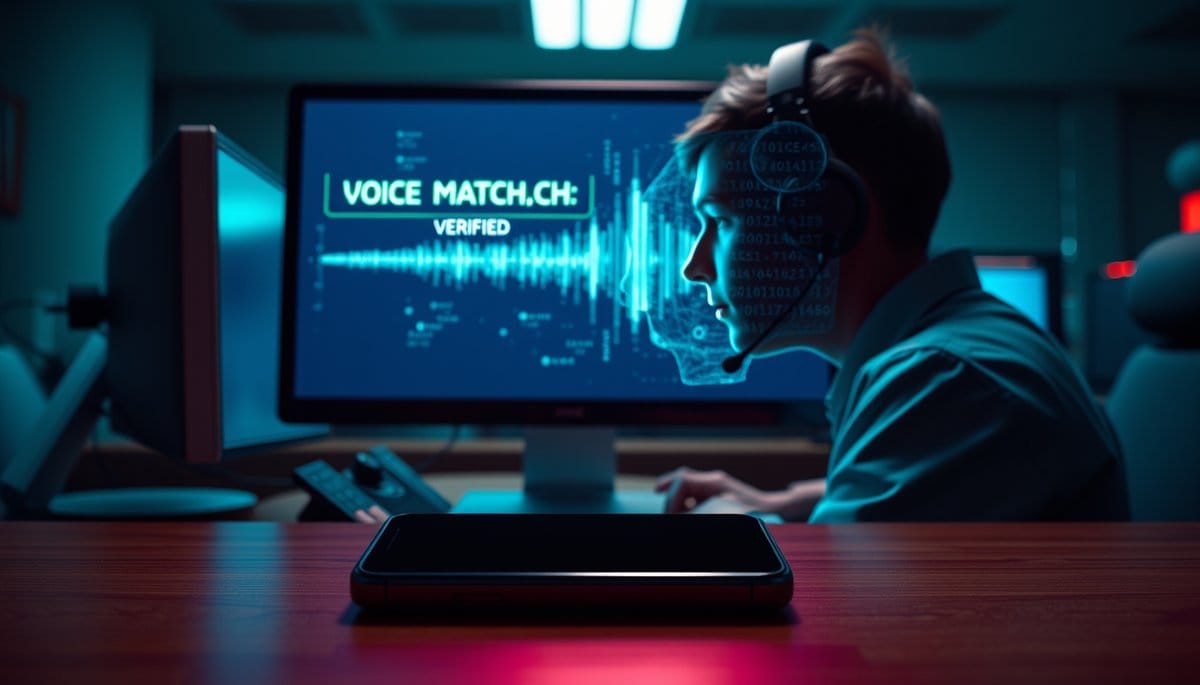
Scammers call banks pretending to be you, using AI-cloned voices to pass voice ID checks and leaked personal data to answer security questions. You won't know it's happening until your card declines or your balance vanishes. Turn off voice biometrics immediately, add a verbal account PIN at your bank and mobile carrier, and freeze your credit today.
The Reporter Who Broke Into His Own Bank With a Fake Voice
In February 2023, Vice reporter Joseph Cox recorded a few minutes of his voice, fed the recording into ElevenLabs' voice-cloning tool, and called his bank, Lloyds. The automated system asked him to speak a passphrase. He played the AI version instead.
It worked. He saw his balance, recent transactions, everything.
That was nearly three years ago using crude tools. Download the same software today and it's substantially better. By July 2025, OpenAI CEO Sam Altman was standing at a Federal Reserve conference calling it "crazy" that banks still trust voiceprints, warning of a "significant impending fraud crisis."
Banks listened. Biometric Update reported that major institutions and identity vendors are now running verification checks throughout the entire call, not just at the start, because the old "verify once and you're in" model falls apart against deepfakes and scripted social engineering.
Here's the uncomfortable part. Most people whose accounts get hit this way never hear anything suspicious. They find out from a declined card or an empty balance.
> If the companies selling identity protection are rebuilding systems on the fly, your bank's phone line is not a safe place for your identity.
How the Fake-You Phone Call Actually Unfolds
The attack is boring, procedural, and fast. That's what makes it work.
1. Harvest your data. Your name, date of birth, address, last four of your Social, old phone numbers. The 2024 National Public Data breach alone exposed hundreds of millions of records. 2. Grab a voice sample. Your voicemail greeting. A birthday video on Instagram. A podcast interview. Modern tools clone convincing voices from under a minute of audio, sometimes much less. 3. Call the bank. The clone handles voice ID or the opening greeting. A live scammer, usually reading a script, handles anything unexpected or types replies into a tool that speaks them in your voice. 4. Pass security questions. Mother's maiden name comes from genealogy sites or public obituaries. Everything checks out. 5. Make one small change. Update the phone number on file. Add a new device. Change the email address. Request a card sent to a different address. It all sounds routine. 6. Cash out. With your one-time codes now going to their phone, money moves through Zelle, wires, or newly opened credit lines.
Step 5 is where they own the account. Once codes start arriving on their device, every security system you set up starts working for them.
Why Your Bank Believes the Fake You
Most advice assumes you're the weak link and tells people to spot scam calls. That's wrong. The person actually getting fooled is a call center agent handling dozens of calls a day, measured partly on speed and customer satisfaction.
That agent hears a calm, normal voice, watches the system flash "verified," and gets correct answers to every question. Refusing would mean treating a real customer like a criminal. Banks lose customers over that.
Voice biometrics make it worse. A green checkmark from the system overrides whatever a human's gut tells them.
Most guides tell people to scrub their voice from social media. If you're spending a Saturday deleting old TikToks, stop. Your voice is already scattered across voicemails, Zoom recordings, and videos on friends' phones that you don't control. You can't un-ring that bell. The fix has to happen on the bank's end.
Honest caveat: I can't tell you exactly how often this attack succeeds. Banks rarely publish breakdowns of account takeovers by attack method, and many get categorized as generic fraud. What's measurable is the trend. It's accelerating.
Lock the Doors Your Bank Left Open
Five moves, about an hour total. Do them in this order.
| Defense | What it blocks | Time |
|---|---|---|
| Opt out of voice ID at your bank | Cloned voice passing automated checks | 10 min |
| Set a verbal account PIN or password with the bank | Leaked-data answers to security questions | 10 min |
| Carrier port-out lock (T-Mobile Account Takeover Protection, Verizon Number Lock, AT&T Wireless Account Lock) | SIM swaps that hijack your codes | 10 min |
| Credit freeze at Equifax, Experian, and TransUnion | New credit lines opened in your name | 20 min |
| Switch 2FA from SMS to an authenticator app or passkey | Code theft after a phone-number change | 10 min |
When I called to disable my voiceprint, the first agent didn't understand what I meant. Say "remove my voice biometric enrollment." Ask them to note on your account that no changes happen by phone without the PIN.
Treat security questions like passwords. Your mother's maiden name should be "Purple Fax Lagoon," stored in a password manager, not the truth.
Key Takeaways
FAQ
Q: How do I know if my bank is using my voice to verify me?
A: Listen for phrases like 'my voice is my password' or a notice that the call is used to verify your identity, then ask an agent directly whether you're enrolled in voice biometrics. Several large banks, including some UK and U.S. institutions, enrolled customers passively during routine calls, so you may be in the system without ever agreeing to it.
Q: Can't my bank's fraud system just detect a fake voice?
A: Some banks run deepfake detection from vendors like Pindrop, and it does catch many synthetic calls. Detection is an arms race, though, and a scammer only needs one bank with weaker tools, so assume your bank's filter will miss some and add your own PIN layer.
Q: What should I do if someone already changed my account details?
A: Call the number on the back of your card immediately, report account takeover, and ask them to reverse any phone, email, or device changes made in the last 30 days. Then contact your mobile carrier to confirm your SIM hasn't been swapped and file a report at IdentityTheft.gov to create a recovery plan.
Conclusion
Right now, someone could be on hold with your bank using your voice and your mother's maiden name from a data breach, and you'd have no idea until your money is gone. Call your bank first thing and turn off voice biometric enrollment. Set a verbal PIN. It takes ten minutes and it shuts down this entire attack.
💡 Lucas's Insight
Related Posts
- How Does AI Voice Cloning Enable Identity Theft?
CrowdStrike's 2026 threat report confirms what security researchers have been dreading: AI-driven identity attacks have become faster, cheaper, and almost indistinguishable from reality. Criminals no longer need your password — they need three seconds of your voice. Here's what's actually happening - How Can Scammers Clone Your Voice in 3 Seconds?
AI voice cloning tools can replicate your voice from a single short audio clip — something freely available on your voicemail, TikTok, or Instagram. Scammers are already using this to call your parents, your boss, and your kids. The defenses are simple, but almost nobody has them set up. - How Are AI Voice Cloning Scams Targeting Seniors?
Scammers now clone a voice from a few seconds of audio and call your parents pretending to be you, in tears, in trouble, needing money in the next hour. A Senate committee just heard the victim testimony. The defense costs ten minutes and zero dollars, and almost no family has set it up.