How Are Criminals Using AI to Fake Police Calls?
A caller ID showing your local sheriff, a badge number, a cloned voice, and a warrant that doesn't exist. AI has turned police impersonation into a scalable industry, and the pressure script is engineered so you never get a chance to verify. The defense takes five minutes to set up.
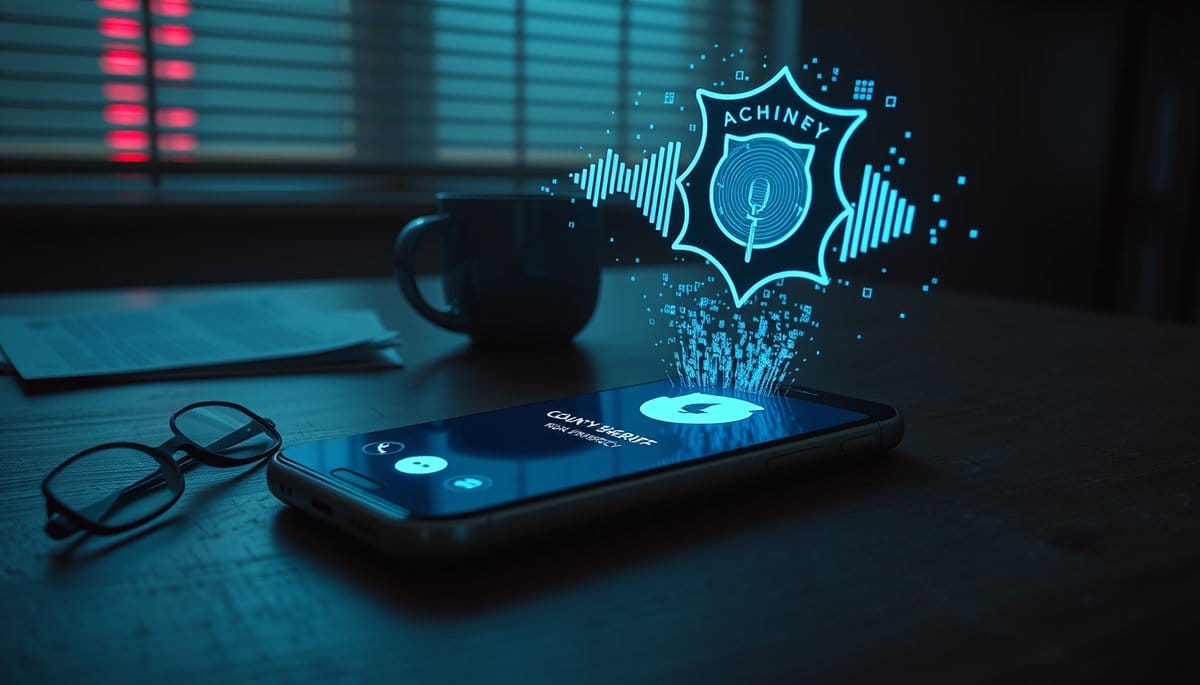
Criminals are combining spoofed caller ID from real police non-emergency lines with AI-cloned voices and fake case numbers to convince people they face imminent arrest, then instruct them to 'protect' their savings by wiring cash, buying gold, or feeding bills into crypto ATMs. No police department in the United States collects bail, fines, or 'protected funds' by phone. If a caller in uniform asks you to move money, you are being robbed, full stop.
The Missed Jury Duty Call That Cost a Retiree $180,000
The pattern shows up in police blotters across the country and it barely varies. A phone rings at 10 a.m. on a weekday. Caller ID reads the county sheriff's non-emergency line, the exact number printed on the department's own website. A calm man identifies himself as a deputy, gives a badge number, and says a bench warrant was issued for failure to appear for jury duty. He reads back the victim's home address to prove legitimacy.
Then the handoff. A second voice, a 'federal agent,' explains the victim's bank accounts have been flagged in a money laundering investigation and the only way to protect the funds is to convert them to gold bullion and surrender them to a courier for safekeeping. Montgomery County, Maryland police alone tracked millions in gold bar handoffs in a single year using this exact script. Victims met a man in a parking lot, handed over bars in a shoebox, and got a receipt with a fake seal on it.
The NCOA has flagged the same emotional engine in the grandparent scam, where the caller claims to be the arresting officer helping a grandchild. AI voice cloning is what upgraded it. The 'grandchild' sobbing in the background is now synthetic, generated from a few seconds of TikTok audio.
Spoofed Badge, Cloned Voice: The Four-Stage Script
This attack is assembled from cheap, legal-adjacent parts. Caller ID spoofing costs pennies per call through offshore VoIP providers. Voice cloning needs roughly three seconds of clean audio and runs on consumer tools. The victim's address, employer, and relatives' names come from data broker records that sell for under a dollar per profile.
| Stage | What you hear | What's actually happening |
|---|---|---|
| 1. Authority | Spoofed sheriff number, badge number, case file number | VoIP spoofing plus a badge number scraped from a real press release |
| 2. Fear | "There's an active warrant. Deputies are being dispatched." | Manufactured deadline to block your ability to think |
| 3. Isolation | "This is a sealed federal case. Discussing it is obstruction." | Cuts off the one person who would say 'that's a scam' |
| 4. Extraction | Wire, gold, gift cards, or a Bitcoin ATM "federal kiosk" | Irreversible payment rails with no chargeback |
Stage three is the load-bearing one. Attackers instruct victims to stay on the phone during the drive to the bank, and coach them on what to tell the teller if asked. Bank staff are trained to intervene on large withdrawals. The scammer knows that, and scripts around it.
Some operators now run a short video call: a person in a uniform shirt, a badge held to the camera, a synthetic face if needed. Ninety seconds of that is enough to erase most people's doubt.
Why Smart People Comply (And Why It Isn't Just Grandma)
Most coverage frames this as an elderly problem. That framing is wrong and it makes younger readers careless. FTC reporting has consistently shown adults in their twenties report losing money to fraud at a higher rate than adults in their seventies. Older victims lose more per incident because they have more to lose, which is a different statement entirely.
Compliance has nothing to do with intelligence. It has to do with a hijacked stress response. When someone credibly threatens your freedom, your prefrontal cortex hands the wheel to your amygdala within seconds. You stop evaluating and start obeying. Every element of the script is designed to keep you in that state: countdown timers, a voice that never raises, a case number you can write down so it feels procedural.
The cruelest part is that verification instincts get weaponized. Victims often do try to check. They ask for a badge number and get one. They ask the caller to prove it and are told to look at their caller ID. That confirmation loop is closed on purpose.
If your defense plan is "I'd never fall for that," you are the ideal target. Confidence removes the pause. The pause is the only thing that saves you.
Four Defenses You Can Set Up Before Dinner
1. **Adopt the hang-up-and-call-back rule, with one catch.** End the call, look up the department's number yourself from the official website, and dial it. The catch: on old copper landlines the caller can hold the line open for up to about 20 seconds after you hang up, so you pick up and hear the same guy answering as 'dispatch.' Use a different phone or wait a full minute. I have watched people get caught by exactly this.
2. **Set a family verification word today.** Four random words, not a birthday, not a pet name. Text it to your parents and adult kids tonight. Any emergency call involving money requires it.
3. **Freeze your credit at Equifax, Experian, and TransUnion.** Fifteen minutes, zero dollars, and it blocks the account-opening fraud that often follows.
4. **Call your bank and add a verbal password plus a hold on same-day wires over a threshold you choose.** Friction on your own account is the point.
Skip the paid call-blocking apps. STIR/SHAKEN caller authentication and carrier spam labels are overrated here because these operators rotate spoofed numbers hourly and often spoof legitimate, verified government lines. Blocking tools are not going to save you. A five-second pause will.
Key Takeaways
FAQ
Q: Can police actually call me about a real warrant?
A: Occasionally a detective will call to schedule a voluntary surrender or an interview, but they will never demand payment or ask you to move funds. If there is any doubt, hang up and call the department's published non-emergency number from a different phone.
Q: My caller ID showed the real sheriff's number. Doesn't that prove it's legitimate?
A: No, and that is the single most dangerous assumption in this scam. Caller ID is trivially forged through VoIP services, and attackers deliberately spoof the exact number listed on the department's website because they know victims will check it.
Q: I already sent money. Is there any chance of getting it back?
A: Speed decides everything. Call your bank's fraud line within the hour to attempt a wire recall, file at reportfraud.ftc.gov and ic3.gov, and notify local police, since gold courier handoffs occasionally get intercepted when reported the same day.
Conclusion
Assume the next call from law enforcement is fake until you have verified it on a number you looked up yourself. Tonight, do two things: text a four-word verification phrase to your parents and adult kids, and call your bank to add a verbal password to your account. Both take under ten minutes, and the version of you that gets this call in six months will not have ten minutes to spare.
💡 Lucas's Insight
Related Posts
- How Are AI Deepfakes Targeting Your College?
AI voice clones and deepfake video calls now impersonate students and university leaders to steal financial aid, redirect tuition, and crack into campus accounts. A 15-second voicemail of you is enough. Here's how the scam runs and how to shut it down. - How Are AI Deepfakes Used in Romance Scams?
Romance scammers are now using real-time AI deepfake video and cloned voices to impersonate attractive strangers — and sometimes even your own family members. The technology costs less than $20/month and is shockingly convincing. Here's what the attack looks like and how to protect yourself today. - How Are AI Deepfakes Stealing Billions From You?
A CFO in Hong Kong wired $25 million after a video call with people who didn't exist. AI deepfakes now clone voices from 3 seconds of audio and generate real-time video of anyone. This is happening to ordinary people right now — not just executives.