How Are AI Deepfakes Stealing Billions From You?
A CFO in Hong Kong wired $25 million after a video call with people who didn't exist. AI deepfakes now clone voices from 3 seconds of audio and generate real-time video of anyone. This is happening to ordinary people right now — not just executives.
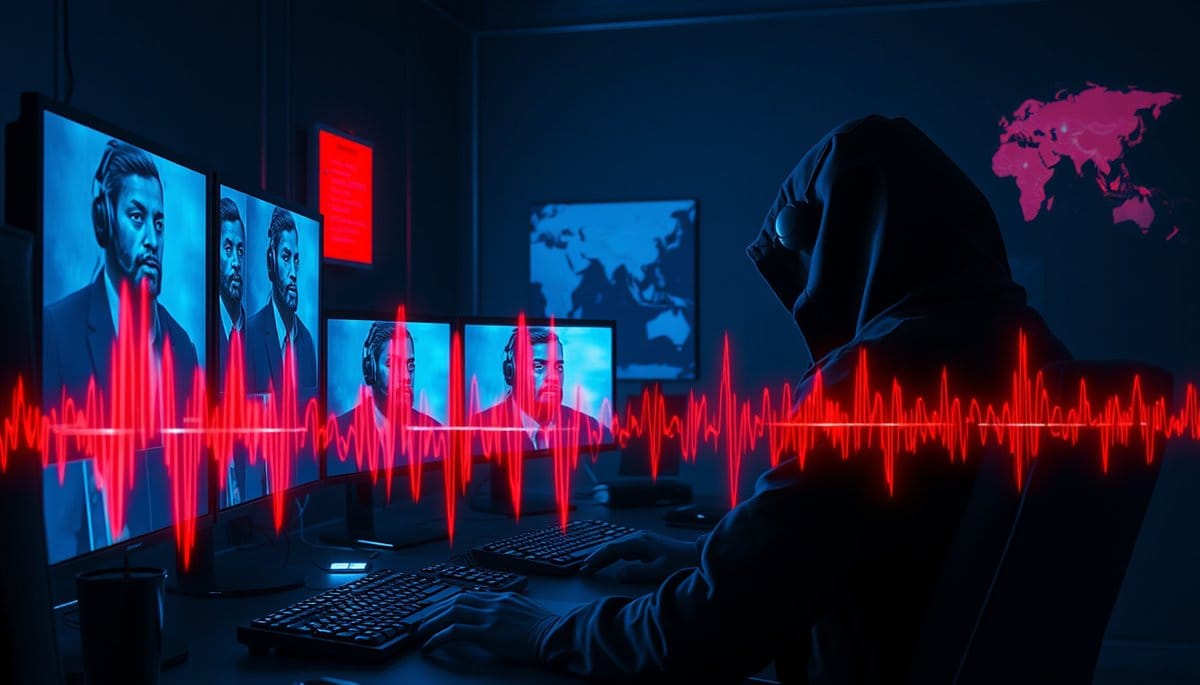
AI deepfake scams use cloned voices and fabricated video to impersonate real people — bosses, family members, bank officials — and trick victims into transferring money or surrendering passwords. This isn't theoretical: a single Hong Kong company lost $25 million in one call, and the tools doing it cost less than a Netflix subscription.
The $25 Million Video Call That Changed Everything
In February 2024, a finance employee at a multinational firm in Hong Kong joined a video conference call with his CFO and several colleagues. He had doubts beforehand — the initial contact had seemed odd. But everyone on the call looked right, sounded right, and behaved professionally. He transferred $25.6 million USD across 15 transactions. Every single person on that call was an AI deepfake. Not one of them was real.
This wasn't a grainy, obviously-fake video. Hong Kong police confirmed the scammers used publicly available footage of the real employees to construct convincing real-time deepfakes. The victim only discovered the fraud after checking with his actual head office.
This case is the clearest proof that deepfake fraud has crossed from 'worrying possibility' into 'active financial weapon.' And while $25 million sounds like a corporate problem, the same underlying technology is now being deployed in $500 'grandparent scams' targeting retirees and in fake CEO voice calls hitting small business owners who can't absorb the loss.
How the Attack Actually Works: Step by Step
The mechanics are simpler than most people realize, which is exactly what makes this so dangerous.
1. **Harvesting your voice or face.** Scammers pull audio from your voicemail greeting, a YouTube video, a podcast, a LinkedIn video post, or even a TikTok. Tools like ElevenLabs or open-source models like Tortoise-TTS can clone a convincing voice from as little as 3 seconds of clean audio. Your face can be captured from any public photo.
2. **Building the fake identity.** Using the cloned voice or a deepfake video model (tools like DeepFaceLive run on consumer GPUs), attackers generate a real-time or pre-recorded version of someone you trust.
3. **Creating the urgent scenario.** The script almost always involves pressure: a car accident, a legal emergency, a wire transfer deadline, a fraud alert. Urgency is the attack vector — it bypasses your rational thinking faster than any technical trick.
4. **The contact.** You receive a call, a WhatsApp message with a voice note, or a video call. The voice sounds like your son. Or your CEO. Or your bank's fraud team.
5. **The ask.** Send money. Give a verification code. Confirm account credentials. The window is short and the pressure is high.
The entire setup — from audio harvesting to first contact — can be executed in under 30 minutes with free or cheap tools.
Why Smart People Fall For This (It's Not Stupidity)
Here's the thing most security guides get wrong: they frame deepfake victims as naive or careless. That's not what's happening. The CFO's employee in Hong Kong wasn't careless — he was deceived by something his brain had no evolutionary reason to distrust.
Human beings are wired to trust familiar voices and faces. Recognition triggers a specific, fast-pathway response in the brain that bypasses skepticism. When you 'see' your daughter's face or 'hear' your manager's voice, the cognitive work of verification feels unnecessary — even rude.
Three facts that should alarm you:
- **3 seconds of audio** is enough for current voice cloning tools to produce a passable replica. You've left more than that on every voicemail you've ever recorded. - **Real-time video deepfakes** now run on a standard gaming laptop. There's no delay, no obvious artifacting under normal video call compression. - **The emotional context is weaponized deliberately.** Scammers script scenarios designed to trigger fear or love — the two emotions that most reliably short-circuit verification instincts.
This part is genuinely hard to measure: we don't know how many people were targeted and said nothing because they're embarrassed. Reported cases are almost certainly a fraction of actual attacks.
Your Defense Checklist: Do These Today, Not Someday
Most advice you'll read says 'be skeptical of unusual requests.' That's useless. Here's what actually works:
**1. Create a family safe word — right now.** Choose a random word (not a name, not a pet) that only your immediate family knows. If you get a distress call from a family member, ask for the safe word. A deepfake cannot know it. Do this tonight at dinner. Write it down somewhere offline.
**2. Hang up and call back on a known number.** If your 'bank,' 'boss,' or 'family member' calls with any urgent financial request, end the call. Call back on a number you independently verified — from the bank's website, from your contacts, from a previous statement. Never call back a number given to you mid-call.
**3. Treat voice-only as unverified.** A voice call alone proves nothing in 2025. Insist on a video call if the stakes are high — and even then, run a liveness check: ask them to do something unpredictable in real time, like hold up three fingers or wave with their left hand. Current deepfake models struggle with rapid, unexpected physical commands.
**4. Lock down your public audio footprint.** Set voicemail to a generic carrier greeting, not your voice. Audit public videos featuring your voice on social media — consider whether they need to be public.
**5. Use a password manager AND a verification phrase for workplace wire transfers.** No legitimate CFO or finance process requires a wire transfer confirmed only by a phone call. If your company doesn't have a dual-authorization protocol for transfers over $5,000, push for one Monday morning.
If you're relying on 'it just sounded weird' as your detection method, you're already behind.
Key Takeaways
- A single deepfake video call cost one Hong Kong company $25.6 million in February 2024 — and the victim had doubts beforehand but was overridden by visual and audio confirmation
- Voice cloning tools like ElevenLabs can replicate your voice from a 3-second audio sample, and your voicemail greeting is more than enough raw material
- The reason victims believe it isn't gullibility — it's neuroscience: familiar voices and faces trigger trust pathways that bypass skepticism before conscious verification even starts
- Set up a family safe word today — a single random word unknown to anyone outside your household that any caller claiming to be family must provide before you act
- Real-time deepfake video on consumer hardware is already here; within 18 months, expect these attacks to become automated and targeted at middle-income households at scale, not just executives
FAQ
Q: How do I know if a call from a family member is real?
A: Ask for your pre-agreed family safe word — any caller who can't provide it should be treated as unverified, regardless of how convincing they sound. If you haven't set one up yet, hang up and call the family member back on their saved contact number before doing anything they asked.
Q: Can phone companies detect AI voice cloning on calls?
A: Honestly, not reliably — not yet. Some carriers are experimenting with call authentication protocols like STIR/SHAKEN, but these verify caller ID legitimacy, not whether the voice itself is AI-generated. Detection tools exist (like Pindrop) but they're enterprise products, not something protecting your personal phone calls today.
Q: What should I do if I think I were targeted by a deepfake scam?
A: If money moved, call your bank immediately — many transfers can be frozen within the first 24 to 48 hours if reported fast enough. Then file a report with the FBI's Internet Crime Complaint Center (IC3) at ic3.gov, which actively tracks these cases and shares data with financial institutions.
Conclusion
Deepfake fraud is no longer a future risk — it's an active, scaling crime that already claimed $25 million in a single call and is moving downstream toward everyday people. The technology is cheap, accessible, and getting faster every month. The one action that will matter most this week: get your family in a room, pick a safe word, and make sure everyone knows to use it before wiring money or sharing any account information with someone who 'called in a panic.' That 30-second conversation could save you everything.