How Do AI Romance Scams Target You?
The man texting you good morning every day may be a language model running on a laptop in a scam compound. AI romance fraud has industrialized: one operator now runs dozens of relationships at once, complete with live deepfake video calls and a fake investment app that shows fake profits.
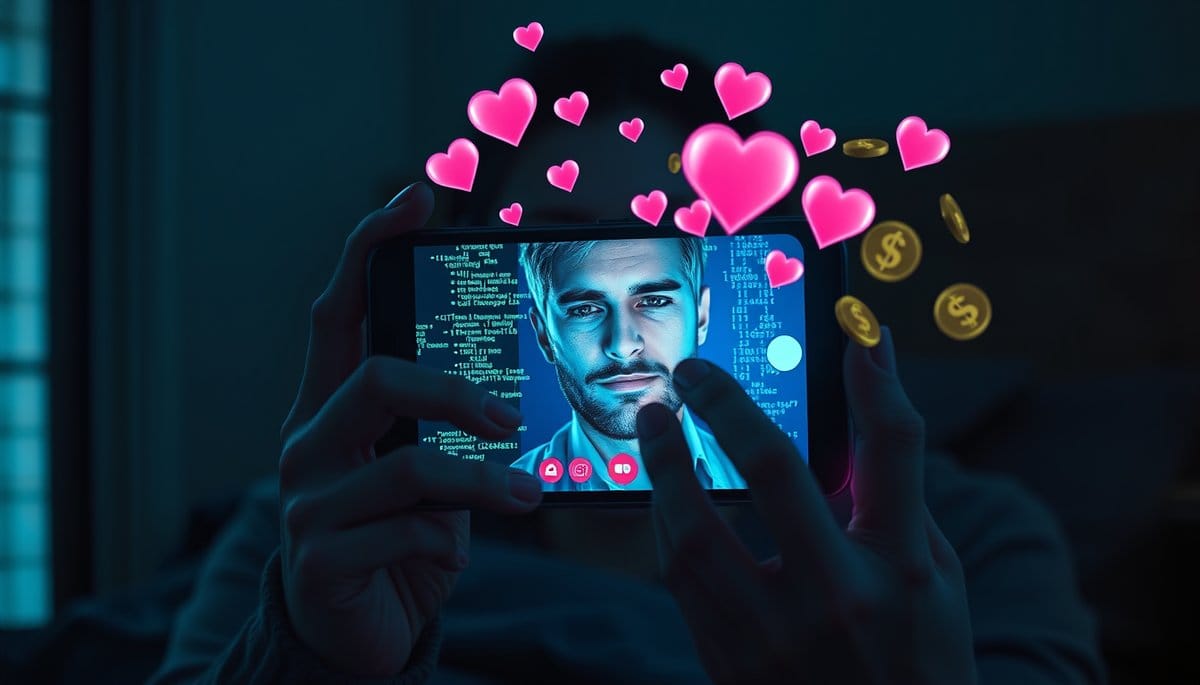
AI romance scams are no longer one lonely fraudster typing badly translated English. A single operator now runs 20 to 30 simultaneous relationships using a language model for the chat, a live face-swap tool for the video calls, and a fake trading app that displays imaginary profits until you try to withdraw. If the person you have never met in physical space eventually mentions an investment opportunity, you are already inside the script.
The 'I Want to Vomit' Case: When the Boyfriend Was Never There
In July 2026, the Associated Press told the story of a woman who sent money to a boyfriend she had never met in person. Her words when she understood what had happened: "I want to vomit." That reaction is the part nobody prepares you for. Victims describe the physical nausea of realizing that months of good-morning texts, voice notes, birthday wishes and shared plans were generated output.
The pattern behind it has an industry name: pig butchering. The scammer fattens the relationship before the slaughter. What changed in the last two years is the labor cost. Writing three months of convincing daily affection used to take a human being real hours. Now a fine-tuned chat model handles the bulk of it, and the operator only steps in for the emotionally decisive moments.
The FBI's Internet Crime Complaint Center has logged more than $650 million a year in confidence and romance fraud, and crypto investment fraud, which is where most romance money actually ends up, has run into the billions annually. Both numbers are undercounts. Shame keeps most victims silent, and researchers who study this consistently estimate that only a small fraction of cases ever get reported.
The 90-Day Script: How a Bot Builds a Boyfriend
The sequence is remarkably consistent across compounds in Southeast Asia and West Africa. Investigators who have recovered operator training manuals find literal scripts, complete with rebuttals for when you get suspicious.
| Phase | Days | What happens | The tell |
|---|---|---|---|
| Contact | 1-3 | "Wrong number" text, or a warm match on Hinge, Tinder, Instagram, even Words With Friends | Photos are polished, few in number, and the profile is under 6 months old |
| Bonding | 4-30 | Constant messaging, voice notes, questions about your job, family, savings | He mirrors your values with unnatural precision |
| Trust proof | 30-60 | Short video calls, a small gift, a "crisis" he solves himself without asking you for money | The video call is brief, poorly lit, and he does not turn his head |
| The hook | 60-90 | Mentions his uncle's trading desk, a gold arbitrage app, a crypto exchange he has "used for years" | The platform is a real-looking web app you have never heard of |
| The harvest | 90+ | Small deposit works, small withdrawal works, then large deposits stop working | Sudden "tax" or "unlock fee" before you can withdraw |
The technical stack is boring and cheap. An LLM writes the affection at scale. A live face-swap tool renders the video call. A cloned exchange front-end, often a rebranded template sold on Telegram, shows a dashboard where your balance goes up every day. That dashboard is a picture. There is no money in it.
Why Smart, Skeptical People Get Taken
Most guides say the victims are lonely older women who do not understand technology. That framing is wrong, and it is dangerous because it makes everyone else feel immune. Reported victims include software engineers, a pediatric surgeon, and plenty of people in their late twenties who grew up online.
The mechanism is not gullibility. It is intermittent reinforcement plus sunk cost. The bot texts at unpredictable intervals, warm then briefly distant, which is the exact rhythm that produces compulsive checking. By the time money enters the conversation, you have invested three months of emotional labor and your brain is protecting that investment, not the cash.
The second mechanism is the small successful withdrawal. You put in $500, you pull out $700, and every skeptical circuit in your head goes quiet. That $200 is the cheapest advertising in fraud.
And here is the friction I will admit honestly: reverse image search, the advice everyone repeats, barely works now. Stolen photos of real people are still common, so it is worth thirty seconds. But increasingly the face does not exist anywhere. It was generated. If you are relying on Google Lens as your safety net, you are relying on a check that fails silently.
Four Tests That Break the Illusion Today
Do these before you send anyone a cent.
1. **The profile test.** During a video call, ask him to turn his head fully to the side, hold a hand flat across his cheek, and then write your name on paper and hold it next to his face. Live face-swap tools break at roughly a 45 to 60 degree head turn and when an object crosses the face plane. The edges smear. Watch the ear and the hairline, that is where it fails first. 2. **The absolute money rule.** Never send money, crypto, or gift cards to someone you have not met in physical space. No exceptions for emergencies, customs fees, medical bills, or opportunities that close tonight. Urgency is the product. 3. **The platform check.** Any investment app introduced by a romantic interest is fraudulent. Not probably. Search the domain registration date on ICANN lookup or who.is. Under a year old means walk away, and check your national regulator's warning list, the UK FCA and Canada's CSA both publish them. 4. **Tell one human.** Scammers explicitly coach you to keep the relationship private. Name one friend as your designated skeptic and tell them everything. The isolation is not romance. It is operational security for the person robbing you.
If money has already gone out, file with IC3.gov within days, contact your bank's fraud team, and if it was crypto, give the wallet address to the report. Chain analysis firms do occasionally freeze funds at exchange off-ramps, though recovery rates stay low.
Key Takeaways
FAQ
Q: Can I get my money back after an AI romance scam?
A: Sometimes, and only if you move fast. Bank wires reported within 24 to 72 hours are occasionally recalled, and crypto sent to a wallet that later touches a regulated exchange can be frozen, but overall recovery rates in pig-butchering cases sit in the single digits, so speed and an IC3 report matter more than anything else.
Q: But we video called. Doesn't that prove he's real?
A: No. Real-time face-swap tools have been running on consumer gaming GPUs since 2023, which is exactly why scammers now offer video calls instead of avoiding them, and the call will always be short, dim, and oddly static. Ask for a live head turn and a handwritten note on camera, then watch the ear and hairline distort.
Q: How do I check someone I'm already talking to?
A: Start with the money question rather than the photo. Ask yourself whether this person has ever mentioned an investment, a platform, a fee, or a crisis involving cash, and if the answer is yes, stop the transaction and tell a friend today. Photo checks are a weak second step because generated faces do not appear in reverse image results.
Conclusion
The cost of faking a devoted partner has collapsed to near zero, which means the volume of these approaches will keep climbing regardless of how careful any one person is. Set the rule tonight: no money to anyone you have not met face to face, ever, and text one friend the name of whoever you are currently talking to online. If that request feels embarrassing, that discomfort is precisely what the script depends on.
💡 Lucas's Insight
Related Posts
- How Are AI Deepfakes Used in Romance Scams?
Romance scammers are now using real-time AI deepfake video and cloned voices to impersonate attractive strangers — and sometimes even your own family members. The technology costs less than $20/month and is shockingly convincing. Here's what the attack looks like and how to protect yourself today. - How Are AI Deepfakes Targeting Your College?
AI voice clones and deepfake video calls now impersonate students and university leaders to steal financial aid, redirect tuition, and crack into campus accounts. A 15-second voicemail of you is enough. Here's how the scam runs and how to shut it down. - How Are AI Deepfakes Impersonating Real Doctors?
Scammers are using AI to clone real doctors' faces and voices, then using those deepfakes to sell fake treatments, steal patient data, and drain bank accounts. The technology is cheap, the fakes are convincing, and most people have no idea it's even possible. Here's what you need to know right now.