What Limits Come With Free API Key Tiers?
Free API key tiers give you limited requests per month, slower rate limits, and no uptime guarantees. Paid tiers unlock higher quotas, priority access, and production-ready SLAs. Choosing the right tier depends on your request volume and reliability needs.
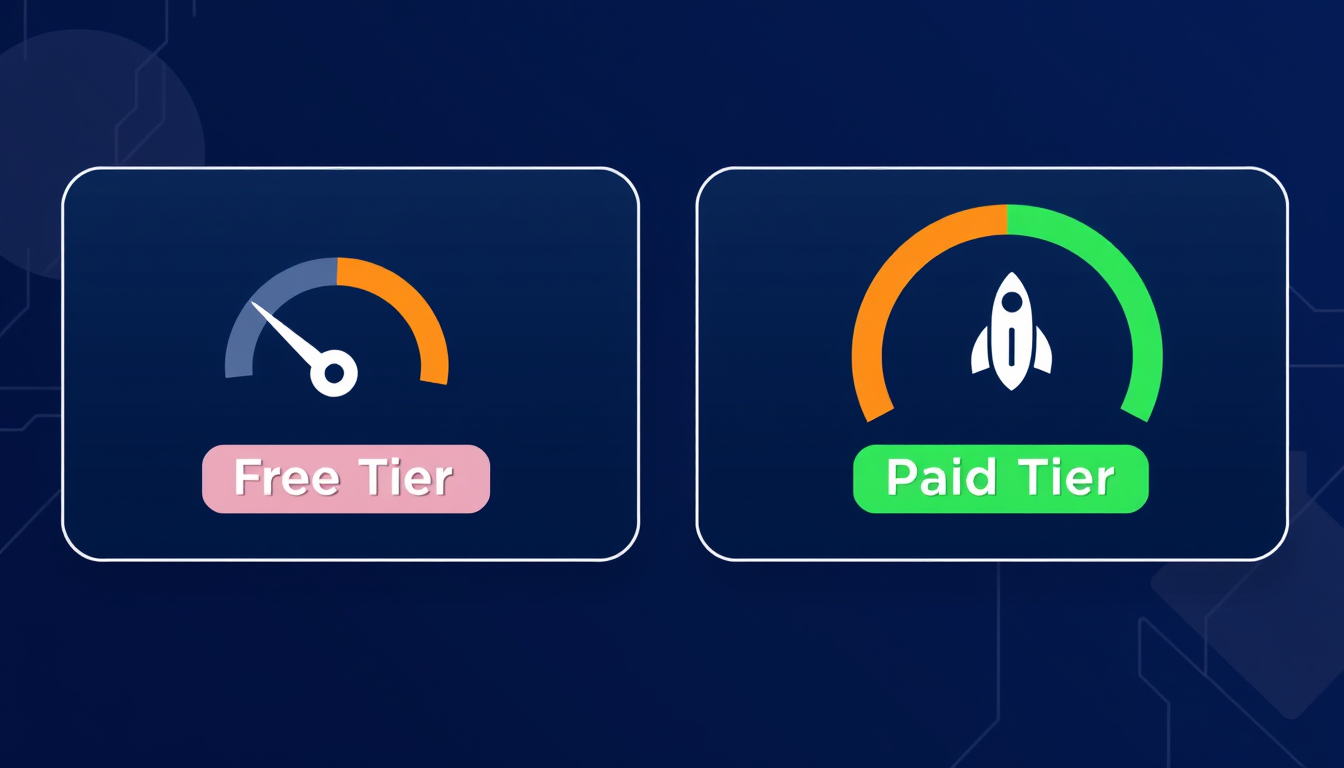
A free API key tier gives you a capped number of requests per day or month, shared infrastructure, and no guaranteed uptime — enough to prototype and test. A paid tier raises or removes those caps, adds priority routing, and typically includes SLA-backed reliability. The right tier depends entirely on whether you are building or shipping.
What Free and Paid API Tiers Actually Control
Every API provider enforces limits through your API key itself. When you make a request, the server checks your key, identifies your tier, and decides whether to serve or reject the call. Free tiers typically restrict three things: request volume (e.g., 500 calls/day), rate limits (e.g., 60 requests/minute), and feature access (e.g., no access to premium models or endpoints). Paid tiers expand all three. For example, OpenAI's free trial gives you $5 of credit with strict rate caps, while a paid tier scales rate limits based on your usage history. The Weather API by weatherapi.com offers 1 million calls/month free but locks historical data and bulk endpoints behind paid plans. These constraints are not arbitrary — free tiers fund infrastructure through upsells, not charity. Understanding what your key's tier controls tells you exactly when a free key will break your app in production.
How to Check Your Tier Limits Before You Hit Them
Most APIs expose your current quota status in response headers. Read these before you run out. Here is a practical example using the OpenWeatherMap API with curl:
```bash curl -i "https://api.openweathermap.org/data/2.5/weather?q=London&appid=YOUR_API_KEY" ```
The `-i` flag prints response headers. Look for fields like `X-RateLimit-Limit`, `X-RateLimit-Remaining`, and `X-RateLimit-Reset`. In Python with the requests library, you can log these proactively:
```python import requests
response = requests.get( "https://api.openweathermap.org/data/2.5/weather", params={"q": "London", "appid": "YOUR_API_KEY"} )
print(response.headers.get("X-RateLimit-Remaining")) print(response.headers.get("X-RateLimit-Reset")) ```
If your remaining count consistently drops to zero before your reset window, that is your signal to upgrade. Most providers also surface this in a dashboard under your account settings, where you can see monthly usage graphs per API key. Check both places — headers give you real-time data, dashboards give you trend data.
When to Upgrade: Practical Pricing and Risk Considerations
The decision to upgrade from a free to a paid API key tier comes down to two factors: volume and reliability. If your app makes fewer than a few hundred calls per day and can tolerate occasional outages, a free tier is fine for side projects or early-stage prototypes. The moment users depend on your app, a free tier becomes a liability. Free tiers rarely include SLAs, which means the provider owes you nothing if the service goes down. Paid tiers typically guarantee 99.9% or higher uptime with compensation clauses. On cost: most APIs use pay-as-you-go pricing above a free baseline. For example, Google Maps Platform charges $2–$7 per 1,000 requests depending on the endpoint, with a $200/month free credit. Budget for realistic usage — calculate your expected daily calls, multiply by 30, and compare against the tier thresholds. Always set a billing cap in your provider dashboard to prevent runaway costs from bugs or traffic spikes. Treat the paid key like a production dependency, not an afterthought.
Key Takeaways
- Free API keys cap your request volume and rate, making them suitable for testing but not production traffic.
- Paid tiers unlock higher quotas, premium endpoints, and SLA-backed uptime guarantees your users can rely on.
- Check response headers like X-RateLimit-Remaining in real time to monitor how close you are to your free tier ceiling.
- Most APIs use pay-as-you-go pricing above a free baseline, so upgrade costs scale with actual usage rather than a flat fee.
- Always set a billing cap in your API provider dashboard to prevent unexpected charges from traffic spikes or bugs.
FAQ
Q: Can I use a free API key in a production app?
A: Technically yes, but it is risky — free tiers lack SLA guarantees and can throttle or reject requests without notice. If real users depend on your app, budget for at least a low-cost paid tier.
Q: Do free and paid API keys look different in the code?
A: No — both are strings you pass in a header or query parameter the same way. The difference is enforced server-side based on what tier that key is registered to.
Q: What happens if I exceed my free tier quota mid-month?
A: The API returns a 429 Too Many Requests error and rejects further calls until your quota resets or you upgrade. Build retry logic with exponential backoff to handle this gracefully in your code.
Conclusion
Free API key tiers are purpose-built for learning and prototyping — they give you real access with guardrails that prevent runaway costs. Paid tiers remove those guardrails and add the reliability guarantees production apps require. Start free, monitor your usage headers actively, and upgrade the moment your app has real users depending on it.
Related Posts
- What Free AI Tools Do Solo Bloggers Need in 2025?
Solo bloggers in 2025 have access to a powerful stack of free AI tools covering writing, research, SEO, and design. The strongest free tier options are ChatGPT, Perplexity AI, Canva AI, Grammarly, and Notion AI. Used together, they replace what previously required a $500/month agency budget. - Why Does Your API Return a 429 Error & How to Fix It?
When you exceed your API rate limit, the server rejects your requests with an HTTP 429 'Too Many Requests' error until your limit resets. Your app stops working until you slow down, wait, or upgrade your plan. Handling this gracefully is a core API skill every developer needs. - How Does Anthropic's OpenClaw API Pricing Work?
Anthropic has blocked Claude Pro and Max subscribers from using their flat-rate plans with third-party AI agent frameworks like OpenClaw, effective April 4, 2026. Developers who relied on subscription plans to power API-driven agents must now pay usage-based API costs on top of their subscription. T