How Does Google's Helpful Content Update Affect You?
Google's Helpful Content Update targets blogs written primarily for search engines rather than real readers. Sites that rely on generic, thin, or AI-generated content without genuine expertise have seen dramatic ranking drops. Bloggers who demonstrate first-hand experience and depth are winning traf
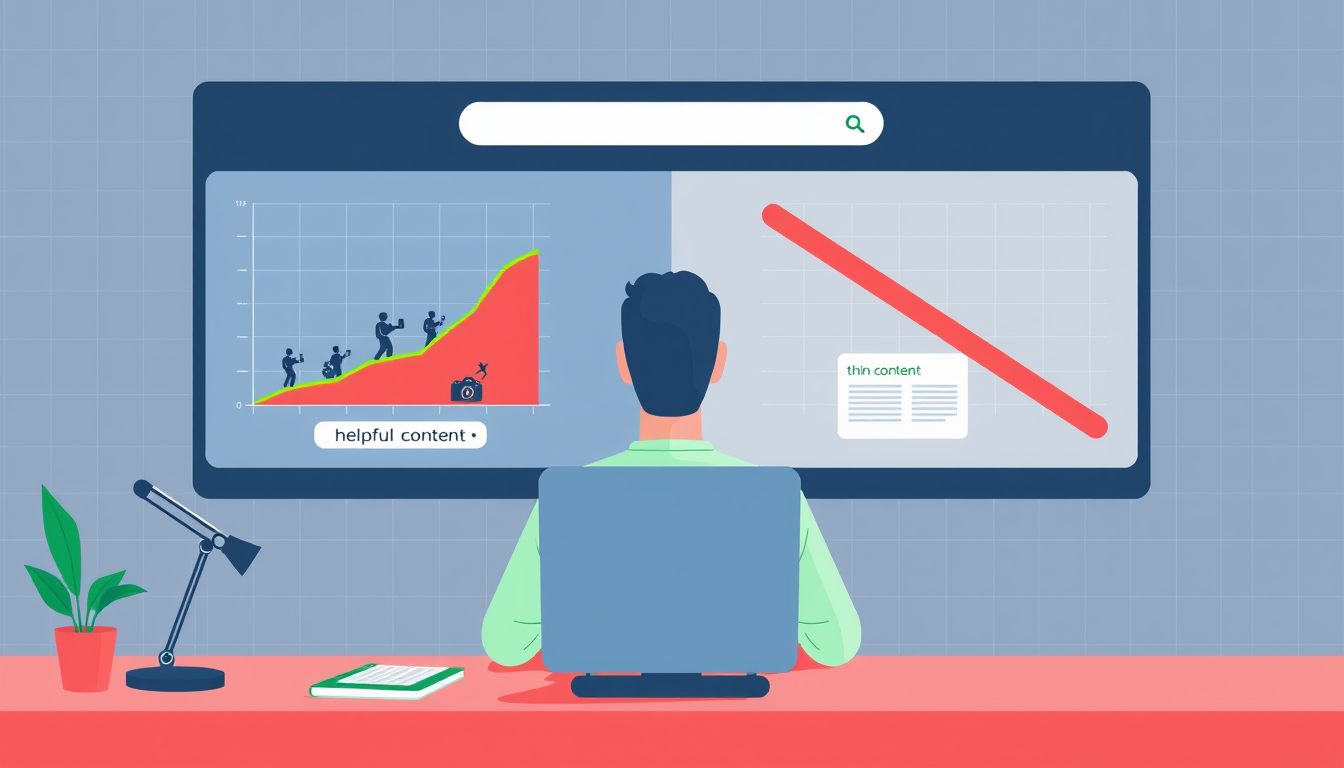
Google's Helpful Content Update (HCU) demotes blogs that exist primarily to rank in search rather than genuinely help a specific audience. It introduced a sitewide classifier, meaning low-quality content anywhere on your site drags down your strongest pages. Bloggers with real expertise, first-hand experience, and content written for humans—not algorithms—have seen traffic grow; those running thin or AI-padded sites have lost 50–90% of organic visibility.
What Google's Helpful Content Update Actually Penalizes
The Helpful Content Update, first rolled out in August 2022 and significantly expanded through 2023, targets what Google calls 'unhelpful content'—posts written to satisfy a search query rather than a real person's need. The key signal Google uses is whether your content demonstrates Experience, Expertise, Authoritativeness, and Trustworthiness (E-E-A-T). This isn't just about word count or keyword density. Google's classifier looks for signals like: does the author have first-hand experience with the topic? Does the content go beyond what's already ranking? Does it leave the reader with something they couldn't get elsewhere? Niche bloggers covering topics they actually live—travel, cooking, personal finance, parenting—have largely benefited. Generalist content farms churning out 50 posts a month on unrelated topics using AI rewrites have been crushed. The update is sitewide, not page-by-page, which is the part most bloggers miss entirely. One bad section of your blog can suppress your best articles.
How to Audit and Fix Your Blog for Helpful Content Standards
Start with a content audit using Screaming Frog or Ahrefs Site Audit. Pull every page with fewer than 500 organic monthly visits and ask: does this post demonstrate personal experience, original insight, or unique data? If the answer is no, you have three options—improve it, consolidate it with a stronger post via 301 redirect, or noindex it. Next, add author bios with verifiable credentials on every post. Link out to primary sources. Add photos, screenshots, or personal anecdotes that prove you've actually done what you're writing about. For AI-generated content specifically: it's not automatically penalized, but generic AI output with no editorial layer is exactly what the classifier flags. Run your posts through a tool like Originality.ai to benchmark your content's human-signal score, then enrich flagged sections with specific examples, dates, and real outcomes. Prioritize your 20 highest-traffic posts first—shore those up before touching anything new. Track ranking changes in Google Search Console weekly after any major edits.
Common Mistakes Bloggers Make After the Helpful Content Update
The biggest mistake is publishing new content aggressively while ignoring existing low-quality posts. Because the classifier is sitewide, 30 thin posts will suppress 5 excellent ones. Fix the dead weight first. Second mistake: chasing topical authority by covering everything in a niche superficially. Google now rewards depth over breadth—one genuinely comprehensive post on a specific problem outperforms ten shallow overviews. Third mistake: removing AI content entirely out of panic. The issue is generic output, not AI assistance. Edited, fact-checked, experience-enriched AI content can perform well. Fourth mistake: ignoring user engagement signals. Google uses Chrome data—time on page, pogo-sticking back to results, scroll depth—as indirect quality signals. Use Microsoft Clarity (free) to watch session recordings and fix pages where users leave in under 30 seconds. Finally, don't expect instant recovery. After cleaning up your content, sitewide classifier updates typically take 1–3 months to re-evaluate your site. Track your 'HCU recovery' by monitoring overall organic impressions in Search Console, not just individual keyword rankings.
Key Takeaways
- The Helpful Content Update uses a sitewide classifier—low-quality posts anywhere on your blog suppress your best-performing pages.
- First-hand experience signals (personal photos, specific outcomes, author credentials) are now direct ranking factors, not optional extras.
- Thin or purely AI-generated content without editorial depth is the primary target—edit and enrich it, don't just delete it.
- A content audit with Ahrefs or Screaming Frog, followed by consolidating or noindexing weak posts, is the fastest recovery path.
- Recovery after cleanup typically takes 1–3 months because Google's classifier re-evaluates sites on a rolling basis, not immediately.
FAQ
Q: Does the Helpful Content Update penalize all AI-written blog posts?
A: No—Google penalizes content that feels generic and provides no value beyond what already exists, regardless of how it was produced. AI-generated posts that are fact-checked, enriched with real experience, and edited for depth can rank well.
Q: How do I know if my blog was hit by the Helpful Content Update?
A: Check Google Search Console for sharp organic impression drops aligned with HCU rollout dates: August 2022, December 2022, September 2023, and March 2024. A drop that began on or just after those dates strongly suggests HCU impact.
Q: What if I deleted all my thin content but traffic hasn't recovered?
A: Deletion alone isn't enough—Google's classifier needs time to re-crawl and re-evaluate your site, which can take 1–3 months. Also ensure deleted pages return 404 or are redirected, and that you've actively improved your remaining content, not just removed the weak posts.
Conclusion
Google's Helpful Content Update fundamentally changed the economics of blogging: volume and keyword targeting no longer compensate for shallow content. The bloggers winning today publish less but go deeper, demonstrate genuine expertise, and treat their audience as the actual customer rather than Google's algorithm. Your single most important next step is to run a content audit this week, identify your weakest 20% of posts by traffic, and either enrich them with real experience or remove them—that one action does more for your rankings than any new post you could write.
Related Posts
- How Do Bloggers Rank in 2026? The Complete SEO Guide
SEO for bloggers in 2026 demands topical authority, structured content that AI engines can parse, and flawless technical foundations. This guide gives you the exact playbook—keyword research through link building—so you rank in both traditional and AI-powered search. - What Are the Real Risks of Using AI for Content Marketing?
AI-generated content carries real risks: factual hallucinations, Google penalties for low-quality output, copyright gray zones, and brand voice erosion. Here's what marketers actually need to watch for and how to mitigate each threat. - What Is Answer Engine Optimization (AEO)? 2026 Guide
Answer Engine Optimization (AEO) is the practice of structuring content so AI-powered search engines select it as the authoritative answer. This 2026 guide covers the full AEO framework: from schema markup and entity optimization to content architecture that wins AI citations.
Also on AI Future Lab
- Quantum Computing Breaks Encryption With 10K Qubits & New Superconductor
Google's quantum breakthrough cuts encryption-breaking requirements to 10,000 qubits while scientists discover hidden superconductivity in iron telluride.