How Does AEO Help Your Content Rank in AI Search?
Traditional SEO wins clicks by ranking pages. AEO wins citations by becoming the definitive answer AI engines quote directly. The shift is from visibility to authority — and the tactics are fundamentally different.
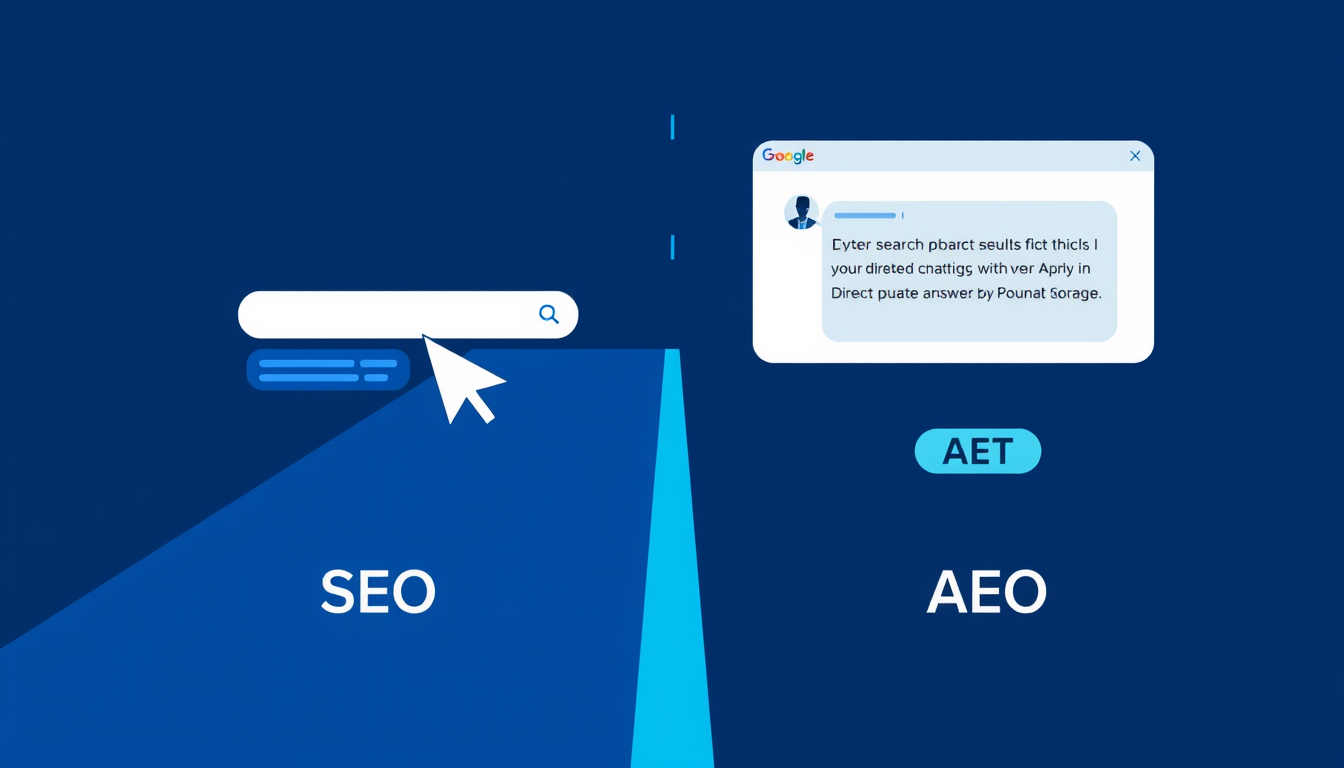
AEO (Answer Engine Optimization) optimizes content to be directly quoted by AI search engines like Perplexity, ChatGPT Search, and Google SGE — not just ranked in blue-link results. Where traditional SEO chases algorithms to earn clicks, AEO structures content so AI engines extract and cite it as the authoritative answer. The goal shifts from a high ranking position to becoming the source AI trusts.
SEO Targets Rankings; AEO Targets Direct Citations
Traditional SEO optimizes for search engine algorithms — targeting keywords, building backlinks, and earning a top-10 ranking so users click through to your page. Success is measured in organic traffic and click-through rates. AEO operates on a different objective entirely. AI answer engines — Perplexity, ChatGPT Search, Google's Search Generative Experience — synthesize responses and cite sources inline. Users never browse a results page; they receive a synthesized answer. AEO success means your content is the source that gets quoted in that answer. This requires structuring content so AI can extract precise, standalone answers rather than forcing users to dig through paragraphs. The metric changes from 'rank position' to 'citation frequency' — how often your content appears as a named source inside an AI-generated response.
AEO Demands Structured Answers, Not Keyword-Dense Prose
SEO content is built around keyword density, semantic clusters, and internal linking — signals that help crawlers assess topical relevance and page authority. The writing style often prioritizes search intent broadly, sometimes burying the direct answer to keep readers on-page longer. AEO flips this completely. AI engines parse content for clear, extractable answers. Content must lead with the direct answer, use explicit question-and-answer formatting, deploy structured data (FAQ schema, HowTo schema, speakable markup), and keep sentences tight and declarative. Ambiguous, hedging, or padded prose gets ignored. AI models reward specificity and confidence. A 2,000-word article that takes 800 words to reach its point will lose a citation to a 400-word post that answers the question in the first paragraph. Structure is the primary ranking signal in AEO.
Authority Signals Differ: Backlinks vs. Trustworthiness Cues
Traditional SEO heavily weights domain authority and backlink profiles — external sites linking to you signal credibility to Google's PageRank-based systems. Building links through outreach, guest posts, and PR campaigns remains a core SEO tactic. AEO draws on different trust signals. AI engines assess source trustworthiness through E-E-A-T markers (Experience, Expertise, Authoritativeness, Trustworthiness), structured data, consistent factual accuracy, and how often a source is already cited across the AI's training data and retrieval index. Named authors with verified credentials, clear publication dates, cited statistics, and institutional affiliations carry significant weight. A site with fewer backlinks but highly structured, factually precise content from credible authors can outperform high-DA competitors in AI citation frequency. This shifts the investment from link acquisition to demonstrable expertise and content precision.
Key Takeaways
- AEO optimizes for AI citation, not search ranking — the destination is inside an AI answer, not a results page.
- Direct, structured answers placed early in content are the single most important AEO formatting principle.
- Schema markup (FAQ, HowTo, speakable) signals to AI engines that your content contains extractable answers.
- E-E-A-T and author credentials replace backlink volume as the primary trust signal in AI-driven search.
- AEO content is measured by citation frequency in AI responses, not click-through rate or organic traffic alone.
FAQ
Q: Can you do AEO and traditional SEO at the same time?
A: Yes — and you should. AEO best practices like structured formatting, clear answers, and schema markup complement SEO without undermining it. Treat AEO as a layer on top of solid SEO foundations, not a replacement.
Q: Does page speed matter for AEO the way it does for SEO?
A: Page speed matters less for AEO because AI engines index and retrieve content rather than users browsing to it. Content structure and factual clarity are far more critical than Core Web Vitals for AI citation performance.
Q: What if my content ranks well in Google but never gets cited by AI engines?
A: High Google rankings don't guarantee AI citations — the content may lack the direct-answer structure AI parsers require. Restructure top-performing posts with explicit Q&A sections and schema markup to bridge the gap.
Conclusion
AEO and traditional SEO share the goal of content visibility but diverge completely in how they achieve it — one earns clicks through rankings, the other earns citations through authoritative, structured answers. As AI search engines handle a growing share of queries, optimizing for citation becomes as critical as optimizing for rank. Start by auditing your highest-traffic content and restructuring it with direct answers, FAQ schema, and clear author authority signals.
Related Posts
- How Does Google's Helpful Content Update Affect You?
Google's Helpful Content Update targets blogs written primarily for search engines rather than real readers. Sites that rely on generic, thin, or AI-generated content without genuine expertise have seen dramatic ranking drops. Bloggers who demonstrate first-hand experience and depth are winning traf - How to Rank in Google AND AI Search Results?
To rank on Google and get cited by AI engines like Perplexity and ChatGPT, you need structured content that answers specific questions directly. Write for humans first, then use schema markup, semantic headings, and cited facts to signal authority to machines. Do both, and you capture traffic from e - How Do Bloggers Rank in 2026? The Complete SEO Guide
SEO for bloggers in 2026 demands topical authority, structured content that AI engines can parse, and flawless technical foundations. This guide gives you the exact playbook—keyword research through link building—so you rank in both traditional and AI-powered search.
Also on AI Future Lab
- [Day 1] Ca₃BeH₂₀ - AI Simulator Activation
[Day 1] Ca₃BeH₂₀ AI Simulator Activation Week 9 | 2026 ⚠️ In-Silico Research Notice This is an in-silico (computational) study. Results a - [Day 5] Ca₂BeH₁₂ (anharmonic + stability) - AI Simulator Activation
[Day 5] Ca₂BeH₁₂ (anharmonic + stability) AI Simulator Activation Week 8 | 2026 ⚠️ In-Silico Research Notice This is an in-silico (comput